
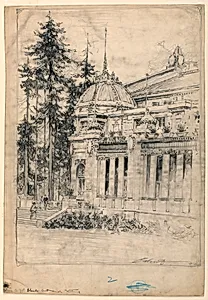
Exhibition Building, Alaska-Yukon-Pacific Exposition
Classification
architecture
Department
Smithsonian Collection
Museum
Smithsonian American Art Museum
Credit
Smithsonian American Art Museum
Accession Number
1961-111-4
Rights
Public Domain
About this artwork
Research in Progress
Art Historical Context
Step into the grandeur of early 20th-century America's optimistic spirit with Frank Calvert's *Exhibition Building, Alaska-Yukon-Pacific Exposition* (1909). This architectural depiction, housed in the Smithsonian American Art Museum's collection, captures a centerpiece of the AYPE, a world's fair held in Seattle from June to October 1909. American architect Frank Calvert (1876–1920), known for his work in exposition design, rendered this structure amid an era of rapid industrialization and regional boosterism. The Alaska-Yukon-Pacific Exposition celebrated the Pacific Northwest's transformation, highlighting the Klondike Gold Rush's legacy, Alaskan resources, and transpacific trade. Spanning 636 acres on the future University of Washington campus, the fair drew over four million visitors with its dazzling pavilions, showcasing technological marvels and cultural exhibits. Calvert's focus on the Exhibition Building—a vast hall for displays—exemplifies the Beaux-Arts-inspired architecture typical of world's fairs, emphasizing symmetry, scale, and spectacle to symbolize progress and unity. Though research on this piece continues, it offers a vivid window into how such temporary marvels fueled national pride and urban growth. Imagine strolling its halls, surrounded by innovations that shaped the modern West!