
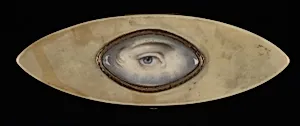
Eye Miniature on an Elliptical Ivory Box
ca. 1800
Medium
Painting-Miniature
Classification
Painting-Miniature
Department
Smithsonian Collection
Museum
Smithsonian American Art Museum
Credit
Smithsonian American Art Museum, Bequest of Mary Elizabeth Spencer
Accession Number
1999.27.77
Rights
Public Domain
Tags
About this artwork
Small paintings of eyes first became popular during the late eighteenth century. They reminded wearers of a loved one, whose identity remained a secret. The single eye also symbolized the watchful gaze of a jealous partner, who feared that his or her lover might stray. One of the earliest known eye miniatures was painted in 1786 by the English artist Richard Cosway for the Prince of Wales, later King George IV. The miniature showed the eye of Mrs. Fitzherbert, the prince's mistress. The eye mini...
Art Historical Context
Nestled in the Smithsonian American Art Museum, the *Eye Miniature on an Elliptical Ivory Box* (ca. 1800) is a delicate jewel of Regency-era sentimentality. Crafted by an unidentified artist, this miniature painting—likely watercolor on ivory—captures a single, expressive eye gazing out from its elegant elliptical case. Miniatures like this were prized for their tiny scale and intricate detail, demanding masterful brushwork to convey emotion in mere millimeters. Eye miniatures surged in popularity during the late eighteenth century as secretive tokens of affection. Worn close to the heart in lockets, brooches, rings, or boxes such as this, they evoked a loved one's presence without revealing their identity. Yet they also carried a sharper edge: the solitary eye symbolized a jealous partner's watchful vigilance, guarding against romantic rivals. One of the earliest examples dates to 1786, when English artist Richard Cosway painted the eye of Mrs. Fitzherbert for the future King George IV, blending romance with royal intrigue. Bequeathed by Mary Elizabeth Spencer, this piece invites us to ponder the hidden passions of the past—whispers of love and suspicion preserved in porcelain-like ivory. A testament to personal artistry amid grand historical shifts, it reminds visitors of love's timeless, enigmatic gaze.
About the Artist
Unidentified ( ) · –