
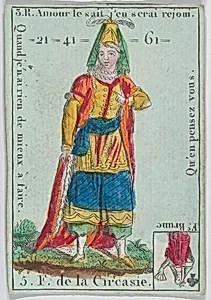
F. de la Circasie from playing cards "Jeu d'Or"
Medium
Etching and hand coloring (watercolor)
Dimensions
3 3/16 × 2 1/16 in. (8.1 × 5.3 cm)
Classification
Prints|Ornament & Architecture
Department
Drawings and Prints
Museum
Metropolitan Museum of Art, New York, NY
Credit
Gift of the Estate of James Hazen Hyde, 1959
Accession Number
59.654.14(9)
Rights
Public Domain
Tags
Art Historical Context
Step into the whimsical world of 18th French gaming with *F. de la Circasie* from the *Jeu d'Or* card deck. This petite etching, measuring just over 3 by 2 inches, captures an elegant female figure amid the ornate designs typical of luxury card sets from the period. Produced anonymously in France between 1700 and 1699, it reflects the era's fascination with decorative prints that blended leisure, fashion, and artistry. The artwork's medium—etching with delicate hand-coloring in watercolor—highlights innovative printmaking techniques of the time. Etching allowed for fine lines and intricate details on a tiny scale, while the watercolor added vibrant, individualized hues, making each card a miniature jewel. Classified under Prints: Ornament & Architecture at The Metropolitan Museum of Art, it exemplifies how playing cards transcended mere games to become collectible ornaments, often featuring women as symbols of beauty and grace. A gift to the Met from the Estate of James Hazen Hyde in 1959, this card evokes the opulent gaming culture of Enlightenment France, where decks like *Jeu d'Or* ("Gold Game") dazzled at aristocratic tables. Its enduring appeal lies in that perfect fusion of playfulness and refinement, inviting us to ponder the hidden artistry in everyday pastimes.
About the Artist
Anonymous, French, 18th century · 1700–1800
The artist known as Anonymous, French, 18th century, represents a collective of unidentified talents active roughly between 1700 and 1800, a period of profound artistic evolution in France from the opulent Rococo to the austere dawn of Neoclassicism and Revolutionary fervor. Little is documented about their personal training or mentors, as their anonymity obscures individual biographies, though th...