
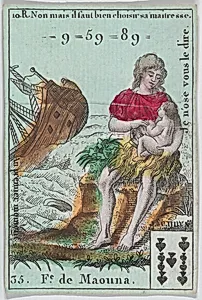
F.e de Maouna from playing cards "Jeu d'Or"
Medium
Etching and hand coloring (watercolor)
Dimensions
3 3/16 × 2 1/16 in. (8.1 × 5.3 cm)
Classification
Prints|Ornament & Architecture
Department
Drawings and Prints
Museum
Metropolitan Museum of Art, New York, NY
Credit
Gift of the Estate of James Hazen Hyde, 1959
Accession Number
59.654.14(29)
Rights
Public Domain
Tags
Art Historical Context
This delicate etching from the "Jeu d'Or" playing card deck captures the charm of 18th-century French printmaking. Created anonymously between 1700 and 1799, the small card—measuring just over three by two inches—features hand-colored details in watercolor, bringing vibrant life to its scene of women, infants, and ships. As part of a themed deck, it likely served both as a functional playing piece and a miniature work of art, reflecting the era’s fascination with decorative luxury and exotic motifs. Etching allowed for intricate line work that could be produced affordably and then personalized through hand coloring, making such prints widely appealing to collectors and players alike. The inclusion of maritime elements alongside domestic figures suggests themes of exploration and family, common in French visual culture during a period of expanding trade and colonial interest. Housed in the Metropolitan Museum’s Department of Drawings and Prints, this card entered the collection as a gift from the Estate of James Hazen Hyde in 1959. It offers a glimpse into the playful yet refined world of 18th-century leisure, where even everyday objects carried artistic and cultural significance.
About the Artist
Anonymous, French, 18th century · 1700–1800
The artist known as Anonymous, French, 18th century, represents a collective of unidentified talents active roughly between 1700 and 1800, a period of profound artistic evolution in France from the opulent Rococo to the austere dawn of Neoclassicism and Revolutionary fervor. Little is documented about their personal training or mentors, as their anonymity obscures individual biographies, though th...