
Fable
n.d.
Medium
Woodcut on paper
Dimensions
Image: 5.3 × 7.8 cm (2 1/8 × 3 1/8 in.); Sheet: 7.9 × 10.3 cm (3 1/8 × 4 1/16 in.)
Classification
wood engraving
Department
Prints and Drawings
Museum
Art Institute of Chicago
Accession Number
20137
Rights
Public Domain
Art Historical Context
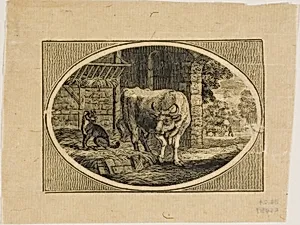
Thomas Bewick's *Fable*, an exquisite wood engraving from the Art Institute of Chicago's Prints and Drawings collection, captures the artist's mastery of a medium that bridged fine art and book illustration in late 18th- and early 19th-century Britain. Bewick (1753–1828), a pioneering English engraver from Newcastle upon Tyne, revolutionized wood engraving by using the end-grain of boxwood, allowing for unprecedented detail and tonal subtlety akin to copperplate etching. This undated print, modestly sized at just 5.3 × 7.8 cm, exemplifies his signature vignettes—small, narrative scenes often drawn from Aesop's fables or British folklore, blending whimsy with moral instruction. What makes Bewick's technique revolutionary was its accessibility: unlike earlier woodcuts, his engravings could be printed alongside letterpress text in affordable books like *Select Fables* (1789) and *A History of British Birds* (1797–1804). *Fable* showcases this precision, with fine lines evoking textures of fur, feathers, and foliage, inviting viewers to ponder its allegorical tale. As a cultural artifact, it reflects the era's fascination with nature study and didactic storytelling, making high art available to everyday readers and cementing Bewick's legacy as the father of modern wood engraving.
About the Artist
Thomas Bewick · 1753–1828
Thomas Bewick (c. 11 August 1753–8 November 1828) was born at Cherryburn in Mickley, Northumberland, the eldest of eight children to tenant farmers John and Jane Bewick. From a young age, he displayed a natural talent for drawing animals and birds observed in the local countryside, without formal art lessons. At age 14 in 1767, he was apprenticed to metal engraver Ralph Beilby in Newcastle upon Ty...