
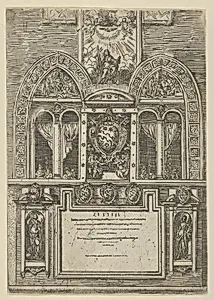
Façade of the Palazzo del Senato in Bologna with the Papal arms at center, with temporary decorations for the entry of Pope Clement VIII in Bologna in 1598
1598
Medium
Etching
Dimensions
Sheet (Trimmed): 8 7/16 × 5 15/16 in. (21.5 × 15.1 cm)
Classification
Prints|Ornament & Architecture
Department
Drawings and Prints
Museum
Metropolitan Museum of Art, New York, NY
Credit
Harris Brisbane Dick Fund, 1937
Accession Number
37.35.2(1)
Rights
Public Domain
Tags
Art Historical Context
This etching by Guido Reni captures a moment of civic celebration in late Renaissance Bologna. Created in 1598, it records the temporary façade decorations on the Palazzo del Senato prepared for Pope Clement VIII’s ceremonial entry into the city. At the center, the papal coat of arms dominates the design, flanked by architectural ornament and festive embellishments that transformed the building for the occasion. Such prints served as both souvenirs and visual records of important public events. Reni, then a young Bolognese artist, employed the etching technique to render fine architectural details with remarkable precision on a modest sheet measuring just over eight by six inches. The medium allowed the image to circulate widely, preserving the ephemeral splendor of the decorations long after the papal visit ended. Classified among prints of ornament and architecture, the work highlights how artists documented and celebrated the intersection of power, religion, and urban spectacle. Today in the Metropolitan Museum’s collection, this print offers viewers a vivid glimpse into the rituals that connected papal authority with local communities at the close of the sixteenth century.
About the Artist
Guido Reni · 1575–1642
Guido Reni (1575–1642) was one of the most celebrated Italian painters of the Baroque era and the dominant figure of the Bolognese School. Born into a family of musicians in Bologna, he trained first with Denys Calvaert before joining the influential Accademia degli Incamminati led by Ludovico Carracci. Reni achieved international fame through his idealizing style that combined Baroque dynamism wi...