
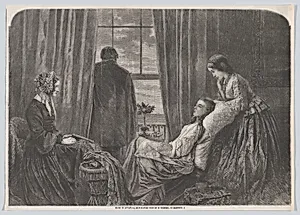
Fading Away, from "Illustrated Times"
October 5, 1858
Medium
Wood engraving
Dimensions
Sheet: 9 7/16 × 13 3/8 in. (24 × 33.9 cm)
Classification
Prints
Department
Drawings and Prints
Museum
Metropolitan Museum of Art, New York, NY
Credit
Gift of Donato Esposito, 2016
Accession Number
2016.774.8
Rights
Public Domain
Tags
Art Historical Context
Henry Peach Robinson's *Fading Away*, published in the *Illustrated Times* October 5, 1858, captures a poignant Victorian deathbed scene through the medium of wood engraving. This depicts a young girl seemingly fading from life, surrounded by a grieving family—a father, mother, doctor, and sister—evoking deep emotional resonance amid themes of mortality and familial bonds. Robinson, a pioneering British photographer, originally created this as a composite photograph, blending five negatives to mimic a painterly composition, which this engraving faithfully reproduces. Wood engraving, a precise intaglio technique where the image is incised into the end-grain of wood blocks, allowed for detailed illustrations in mass-produced periodicals like the *Illustrated Times*. At 9 7/16 × 13 3/8 inches, this sheet-sized print made Robinson's innovative work accessible to a wide audience, bridging photography's novelty with traditional printmaking. It exemplifies mid-19th-century pictorialism, where artists staged scenes to elevate photography as fine art, influenced by Pre-Raphaelite realism and narrative painting. Culturally, *Fading Away* stirred debate: praised for its pathos reflecting tuberculosis's toll on Victorian families, yet criticized for its artificiality. Today, housed in the Metropolitan Museum of Art's Drawings and Prints department (gift of Donato Esposito, 2016), it highlights how prints democratized art, immortalizing personal tragedy in an era obsessed with sentimental imagery.