
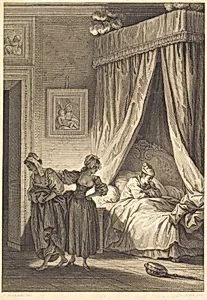
La gageure des trois commeres: La servante
Medium
etching and engraving
Classification
Department
CG-E
Museum
National Gallery of Art, Washington, D.C.
Credit
Rosenwald Collection
Accession Number
1953.6.170
Rights
Public Domain
Art Historical Context
In the opulent world of 18th-century French Rococo, *La gageure des troisères: La servante* (Theager of the Three Goss: The Maidservant captures the playful mischief of everyday life. Created between 1751 and 1775 as an etching and engraving by Triere and Antoine-Jeanclos after Jean-Honor Fragonard, this reproduces one of Fragonard's lively scenes from his series on gossiping women and their wager. Fragonard, a master of the Rococo style, delighted in exuberant compositions filled with swirling fabrics, expressive gestures, and subtle eroticism, reflecting the era's fascination with leisure, flirtation, and social satire amid the aristocracy's indulgent pursuits. The medium of etching and engraving was pivotal in the Enlightenment period, allowing intricate details—like the maidservant's dynamic pose and the gossips' animated chatter—to be widely disseminated as affordable prints. This technique preserved Fragonard's fluid brushwork in precise lines, making high art accessible beyond elite salons. Housed in the National Gallery of Art's Rosenwald Collection (Department CG-E), it exemplifies how reproductive prints fueled the spread of Rococo's whimsical charm, bridging intimate domestic humor with broader cultural commentary on gender and gossip in pre-Revolutionary France. A delightful glimpse into a bygone era's lighthearted intrigues!