
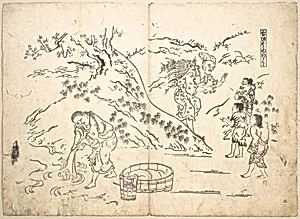
Fagot–gatherer Finds Boy with Sparrow
Medium
Monochrome woodblock print; ink on paper
Dimensions
H. 11 1/2 in. (29.2 cm); W. 15 3/4 in. (40 cm)
Classification
Prints
Culture & Period
Japan · Edo period (1615–1868)
Department
Asian Art
Museum
Metropolitan Museum of Art, New York, NY
Credit
H. O. Havemeyer Collection, Bequest of Mrs. H. O. Havemeyer, 1929
Accession Number
JP1596
Rights
Public Domain
Tags
Art Historical Context
In the vibrant world of Edo-period Japan (1615–1868), Okumura Masobu's *Fagot-Gatherer Finds Boy with Sparrow* a fleeting moment of everyday discovery. This monochrome woodblock print, rendered in ink on paper, exemplifies the ukiyo-e tradition—"pictures of the floating world"— celebrated ordinary life amid nature. Masanobu (1686–1764), a pioneering printmaker, was renowned for his innovative techniques, including early experiments with color, though this work's stark black ink highlights the elegance of sumizuri-e (ink-only prints), allowing subtle gradations of tone to evoke depth and texture. The scene unfolds in a wooded setting, where a fagot-gatherer (a wood-bundle collector) encounters a boy cradling a sparrow, joined by figures of men and women amid trees and birds. Such genre depictions reflected Japan's urbanizing society, blending rural simplicity with human tenderness. The print's intimate scale—11½ × 15¾ inches—made it accessible for collectors, underscoring woodblock printing's democratic appeal. Housed in the Metropolitan Museum of Art's Asian Art Department from the H.O. Havemeyer Collection, this piece showcases Masanobu's mastery in storytelling through line and shadow, offering visitors a window into 18th-century Japan's poetic observation of the natural and human realms.
About the Artist
Okumura Masanobu · 1686–1764
Japanese, 1686–1764