
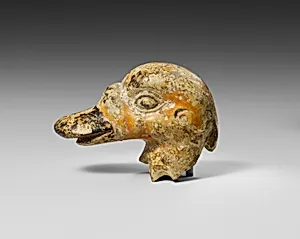
Faience fragment of a duck askos (flask with spout)
Unknown Artist
ca. 2nd century BCE
Medium
Faience
Dimensions
h. 1 9/16 in. (3.9 cm); w. 2 5/16 in. (5.8 cm)
Classification
Miscellaneous-Faience
Culture & Period
Greek, Ptolemaic · Hellenistic
Department
Greek and Roman Art
Museum
Metropolitan Museum of Art, New York, NY
Credit
Gift of Frieda Tchacos, 1997
Accession Number
1997.292
Rights
Public Domain
Tags
Art Historical Context
This charming faience fragment depicts part of a duck-shaped *askos*, a small flask with a spout designed for pouring oils,, or liquids in daily rituals. Crafted around the 2nd century BCE during the Hellenistic Ptolemaic period, it measures just 1 9/16 inches high and 2 5/16 inches wide, the exquisite miniaturization of ancient Greek artistry under Egyptian influence. Produced in the vibrant blue-green glaze typical of faience—a silica-based ceramic prized for its jewel-like sheen—this piece reflects the fusion of Greek realism and Ptolemaic opulence following Alexander the Great's conquests. Faience, an ancient Egyptian specialty, gained popularity in Hellenistic workshops for luxury goods, showcasing advanced glazing techniques that created a durable, colorful surface mimicking precious stones. The duck form, a whimsical yet symbolic motif in Greek and Egyptian art, may evoke abundance or the Nile's wildlife, blending playfulness with functionality. Though a fragment, it captures the period's delight in naturalistic animal shapes, evoking everyday life in Alexandria's cosmopolitan markets. Today, this delicate treasure resides in the Metropolitan Museum of Art's Greek and Roman Art Department, a gift of Frieda Tchacos in 1997, offering visitors a glimpse into the innovative craftsmanship of a dynamic era.