
Faith
Classification
Department
CG-E
Museum
National Gallery of Art, Washington, D.C.
Credit
Rosenwald Collection
Accession Number
1943.3.262
Rights
Public Domain
Art Historical Context
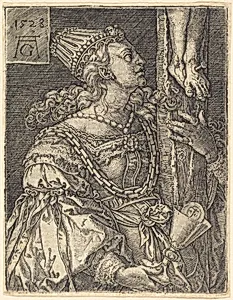
Heinrich Aldegrever's *Faith* (1528) is a delicate print from the Northern Renaissance, crafted by one of the "Little Masters"—German engravers celebrated for their masterful work in miniature formats. Born around 1502 in Soest, Aldegrever was a goldsmith-turned-printmaker whose intricate engravings drew inspiration from Albrecht Dürer and the era's religious upheavals, including the Protestant Reformation sparked by Martin Luther a decade earlier. This piece likely personifies the theological virtue of Faith, a common motif in 16th-century art symbolizing steadfast belief amid turbulent times. As a print, *Faith* exemplifies the revolutionary medium of engraving, which allowed detailed imagery to be reproduced affordably and widely disseminated—democratizing art for a growing audience beyond wealthy patrons. Aldegrever's technique shines in his precise line work, capturing folds of drapery, symbolic attributes, and expressive figures with remarkable clarity, even at small scale. Housed in the National Gallery of Art's Rosenwald Collection (Department CG-E), this work invites visitors to ponder the interplay of devotion and artistry in Reformation-era Europe, where prints like this served both devotional and decorative purposes. A testament to Aldegrever's enduring legacy, it reminds us how faith—in art and spirit—transcends centuries.
About the Artist
Heinrich Aldegrever · 1502–1561
Heinrich Aldegrever, born in 1502 in Paderborn, Westphalia, to parents Herman and Katherine Trippenmeker—a family of clog-makers known by the dialect name Trippenmecker—emerged as a multifaceted artist in the German Renaissance. His early training remains undocumented, though he likely apprenticed in a Soest goldsmith's workshop after relocating there around 1525, where he joined the painters' gui...