
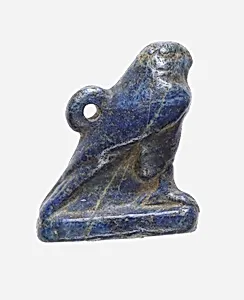
Falcon amulet
Unknown Artist
664–332 B.C.
Medium
Lapis lazuli
Dimensions
H. 2.2 cm (7/8 in.)
Classification
Amulet, falcon
Period
Late Period
Department
Egyptian Art
Museum
Metropolitan Museum of Art, New York, NY
Credit
Purchase, Edward S. Harkness Gift, 1926
Accession Number
26.7.895
Rights
Public Domain
Tags
Art Historical Context
This exquisite falcon amulet, carved from vibrant lapis lazuli, hails from Egypt's Late Period (664–332 B.C.), specifically Dynasties 26–30. Measuring just 2.2 cm high, its petite scale belies its profound cultural weight. Crafted by an unknown artist, it exemplifies the enduring tradition of small-scale Egyptian jewelry designed for personal adornment or ritual use. Acquired by the Metropolitan Museum of Art 1926 through the Edward S. Harkness, it now resides in the Egyptian Art department. In ancient Egyptian belief, the falcon was a sacred emblem of Horus, the sky god and protector of the pharaoh, symbolizing power, kingship, and divine oversight. Amulets like this were worn as talismans to ward off evil, ensure safe passage in the afterlife, or invoke the god's watchful gaze. During the Late Period—a time of political fragmentation yet artistic revival amid Persian and Nubian influences—such objects reflected a resurgence of traditional iconography, blending piety with portable magic. The choice of lapis lazuli, a prized semi-precious stone imported from distant Afghanistan, underscores its elite status. Its deep blue hue evoked the night sky and the primordial waters of creation, amplifying the amulet's protective potency. Carved with precision, this tiny masterpiece invites us to marvel at the Egyptians' masterful fusion of artistry, spirituality, and everyday devotion.