
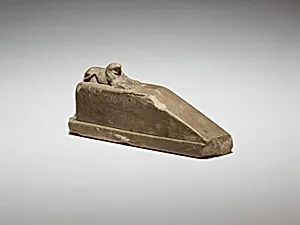
Falcon-headed sphinx recumbent on a pedestal with a ramp, and a feline(?) behind, possibly a gnomon for a shadow clock or instrument
Unknown Artist
664–30 B.C.
Medium
Ivory
Dimensions
L. 6.9 × W. 1.6 × H. 3 cm (2 11/16 × 5/8 × 1 3/16 in.)
Classification
Amulet, sphinx, falcon-headed, pedestal
Period
Late Period–Ptolemaic Period
Department
Egyptian Art
Museum
Metropolitan Museum of Art, New York, NY
Credit
Gift of J. Pierpont Morgan, 1917
Accession Number
17.194.2474
Rights
Public Domain
Tags
Art Historical Context
This exquisite ivory carving from Egypt's Late Period to Ptolemaic era (664–30 B.C.) depicts a recumbent falcon-headed sphinx on a pedestal with a ramp, accompanied by a mysterious feline figure behind it. Measuring just 6.9 cm long, this diminutive artifact showcases the mastery of ancient Egyptian carvers, who transformed elephant tusk into intricate, lifelike forms through careful incision and polishing. The falcon head evokes Horus, the sky god and protector, merging with the sphinx's traditional lion body to symbolize royal power and divine guardianship. The object's possible role as a gnomon—a component for a shadow clock or astronomical instrument—highlights Egypt's advanced knowledge of timekeeping and celestial observation during this cosmopolitan phase, influenced by Greek Ptolemaic rule. Such hybrid figures blend sacred iconography with practical function, reflecting a culture where art served both ritual and science. Though its exact use remains speculative, it exemplifies the Late Period's fascination with protective deities and precise craftsmanship. On view in the Metropolitan Museum of Art's Egyptian Art department (Gift of J. Pierpont Morgan, 1917), this rare piece invites us to ponder the ancient Egyptians' harmonious fusion of mythology, technology, and artistry.