
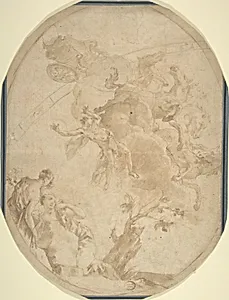
Fall of Phaeton
Medium
Brush and brown wash over black chalk on light tan paper. Oval format. Oval framing outline in brown ink
Dimensions
11-1/2 x 8-9/16 in. (29.1 x 21.8 cm)
Classification
Drawings
Department
Drawings and Prints
Museum
Metropolitan Museum of Art, New York, NY
Credit
Gift of Cornelius Vanderbilt, 1880
Accession Number
80.3.523
Rights
Public Domain
Tags
Art Historical Context
Behold the dramatic *Fall of Phaeton a 17th-century drawing by an artist from the Roman-Bolog school, capturing a pivotal moment from classical mythology. Phaeton, the youthful son of the sun god Apollo, disastrously took the reins of his father's celestial chariot, losing control and plummeting to earth amid rearing horses and a shattered carriage. This oval composition, measuring 11-1/2 x 8-9/16 inches, pulses with Baroque energy, evoking the turbulent skies and human hubris central to tales from Ovid's *Metamorphoses*. Executed in black chalk with fluid brush and brown wash on light tan paper, the work showcases masterful techniques of the Italian draftsmanship tradition. The underdrawing provides structure, while the wash adds depth and motion—horses' muscles strain, figures twist in panic, and an inked oval frame enhances its jewel-like focus. Roman-Bolognese artists, influenced by Carracci dynamism, favored such preparatory studies for paintings or frescoes, blending realism with theatrical flair. A treasured gift to the Metropolitan Museum of Art from Cornelius Vanderbilt in 1880, this drawing invites us to ponder 17th-century Italy's reverence for antiquity amid the Counter-Reformation's artistic fervor. Gaze closely to feel the myth's timeless thrill!