
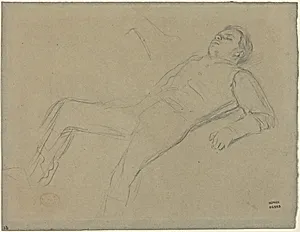
Fallen Jockey (study for "Scene from the Steeplechase: The Fallen Jockey")
c. 1866
Medium
graphite on blue paper
Dimensions
overall: 26 x 34.3 cm (10 1/4 x 13 1/2 in.)
Classification
Drawing
Department
CG-E
Museum
National Gallery of Art, Washington, D.C.
Credit
Collection of Mr. and Mrs. Paul Mellon
Accession Number
1999.79.6
Rights
Public Domain
Art Historical Context
In the mid-1860s, Edgar Degas captured the raw drama of horse racing in *Fallen Jockey*, preparatory drawing for his ambitious painting *Scene from the Steeplechase: The Fallen Jockey*. At this early stage of his career, Degas fascinated by modern life in Paris, particularly the excitement of the racetrack, where jockeys and thoroughbreds embodied speed, tension, and human vulnerability. This graphite study on blue paper, measuring just 26 x 34.3 cm, reveals his keen eye for anatomy and movement, sketching a tumbled jockey amid the chaos of a steeplechase fall. Degas's use of graphite on toned blue paper was masterful, allowing subtle highlights to emerge where the paper's color recedes, creating a sense of depth and immediacy without full color. As a Realist edging toward Impressionism, he filled sketchbooks with such studies, honing his technique through direct observation. This intimate drawing showcases his preparatory process—precise lines dissecting limbs and fabric—foreshadowing his later masterpieces of ballet and urban scenes. Today, housed in the National Gallery of Art's Collection of Mr. and Mrs. Paul Mellon, *Fallen Jockey* invites visitors to appreciate Degas's evolution from meticulous draftsman to innovator, reminding us how a single study can pulse with the thrill of the turf.
About the Artist
Edgar Degas · 1834–1917
Edgar Degas (1834-1917) stands as one of the most innovative artists of the nineteenth century, whose distinctive vision transformed how modern life could be depicted on canvas. Born Hilaire-Germain-Edgar De Gas in Paris to a wealthy banking family—his father French, his mother a Louisiana Creole from New Orleans—Degas received a classical education before abandoning law studies in 1855 to pursue ...