
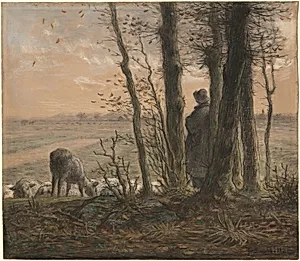
Falling Leaves
c. 1866
Medium
pastel and conté crayon on wove paper
Dimensions
Unframed: 14 1/2 x 17 in. (36.8 x 43.2 cm)
Classification
Drawing
Department
CG-E
Museum
National Gallery of Art, Washington, D.C.
Credit
Corcoran Collection (William A. Clark Collection)
Accession Number
2014.136.180
Rights
Public Domain
Art Historical Context
Jean-François Millet, a leading figure in the Barbizon School and French Realism, masterfully captured the quiet poetry of rural life in *Falling Leaves* (c. 1866). This intimate drawing depicts the gentle descent of autumn foliage, evoking the cyclical rhythms of nature and the peasant existence Millet knew intimately from his Barbizon years. Created during his mature period, when he increasingly explored landscape motifs alongside figures, the work reflects his empathy for the land and its laborers, themes that influenced later artists like the Impressionists. Millet employed pastel and conté crayon on wove paper—a smooth, versatile support ideal for his subtle layering techniques. Conté crayon, a dense, chalky medium invented in the 18th century, allowed for rich tonal contrasts and velvety textures, mimicking the soft haze of falling leaves and dappled light filtering through branches. Pastel added luminous highlights, enhancing the atmospheric depth. At 14½ × 17 inches, its modest scale invites close contemplation, revealing Millet's precision in rendering fleeting natural moments. Part of the prestigious Corcoran Collection (William A. Clark Collection) at the National Gallery of Art, *Falling Leaves* exemplifies Millet's draftsmanship, bridging observation and emotion. Visitors will appreciate how this drawing, though preparatory in feel, stands alone as a meditation on transience, reminding us of autumn's bittersweet beauty.
About the Artist
Jean-François Millet · 1814–1875
Jean-François Millet (1814-1875) was a French painter and one of the founders of the Barbizon school, whose dignified depictions of peasant laborers transformed how art could represent rural life. His monumental images of sowers, gleaners, and field workers elevated common people to subjects previously reserved for mythological or historical figures, making him a pivotal figure in the development ...