
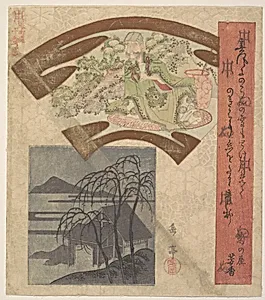
Fan-shaped Design Depicting Chinese Poet or Philosopher
Medium
Woodblock print (surimono); ink and color on paper
Dimensions
8 1/8 x 7 1/4 in. (20.6 x 18.4 cm)
Classification
Prints
Culture & Period
Japan · Edo period (1615–1868)
Department
Asian Art
Museum
Metropolitan Museum of Art, New York, NY
Credit
H. O. Havemeyer Collection, Bequest of Mrs. H. O. Havemeyer, 1929
Accession Number
JP1826
Rights
Public Domain
Tags
Art Historical Context
This exquisite fan-shaped woodblock print, *Fan-shaped Design Depicting Chinese or Philosopher*, was by Yashima Gaki, a master of the ukiyo-e tradition during Japan's Edo period (16151868). Gakutei (1786?–1868), known his poetic and refined style, specialized in *surimono*—luxurious, privately commissioned prints often produced for special occasions like New Year's greetings. Crafted with ink and color on paper, intimate work measures just 8 1/8 x 7 1/4 inches, perfectly suited for mounting on a hand fan. The design centers on a contemplative Chinese poet or philosopher, evoking the era's fascination with East Asian literati culture and classical figures. Subtle landscape elements in the background add depth, blending human introspection with nature's serenity—a hallmark of Gakutei's delicate line work and vibrant, layered colors achieved through meticulous woodblock carving. *Surimono* like this one stood out for their high-quality printing techniques, sometimes incorporating embossing or metallic pigments for a tactile, jewel-like effect. Housed in the Metropolitan Museum of Art's Asian Art Department as part of the H. O. Havemeyer Collection (1929 bequest), this print offers a window into Edo Japan's vibrant print culture, where art bridged elite patronage and everyday elegance, celebrating wisdom and beauty in compact form.
About the Artist
Yashima Gakutei · 1786–1868
Yashima Gakutei (c. 1786–1868), born in Osaka as the illegitimate son of a Tokugawa shogunate samurai named Hirata, adopted the name from his mother's subsequent marriage into the Yashima clan. Little is documented about his early years beyond these familial ties, but he pursued artistic training under the esteemed ukiyo-e masters Totoya Hokkei and Katsushika Hokusai, absorbing their precision in ...