
Fan
1750-1775
Medium
Decorative Arts
Classification
Decorative Arts
Department
Smithsonian Collection
Museum
Smithsonian American Art Museum
Credit
Smithsonian American Art Museum, Bequest of Mrs. Henry L. Milmore through Mr. Henry L. Milmore
Accession Number
1956.6.1
Rights
Public Domain
Tags
Art Historical Context
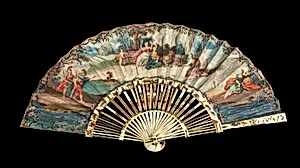
This elegant French fan, crafted between 1750 and 1775, exemplifies the opulent decorative arts of the Rococo period. Adorned with delicate scenes of classical figures in flowing drapery—men and women at leisure, accompanied by playful putti (cherubic children)—it captures the era's fascination with mythology, pastoral idylls, and lighthearted revelry. Fans like this were not mere accessories but coveted status symbols among the French aristocracy, often hand-painted on silk, paper, or ivory with intricate gouache or watercolor techniques that allowed for luminous colors and fine details. Historically, such fans flourished during Louis XV's reign, serving as multifunctional objects for cooling, flirting, and subtle social signaling in grand salons. The classical motifs reflect the Enlightenment's revival of ancient Greek and Roman ideals, blending whimsy with sophistication. Though the artist remains unidentified, the fan's refined execution highlights the anonymous mastery of French ateliers. Today, housed in the Smithsonian American Art Museum through the bequest of Mrs. Henry L. Milmore, this piece invites visitors to glimpse 18th-century refinement, where everyday elegance intertwined with high art. (198 words)
About the Artist
Unidentified (French)
Georges Hugnet (1906–1974) was a multifaceted French artist, poet, writer, and critic whose innovative collages and graphic works bridged Dada and Surrealism. Born in Paris on July 11, 1906, he spent much of his early childhood in Buenos Aires, Argentina, returning to France around 1913. His early life and artistic training remain sparsely documented, with no records of formal art school attendanc...