
Fan
1850-1870
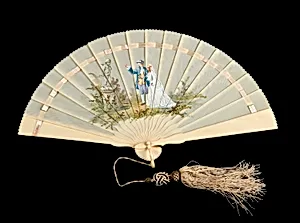
Medium
Decorative Arts
Classification
Decorative Arts
Department
Smithsonian Collection
Museum
Smithsonian American Art Museum
Credit
Smithsonian American Art Museum, Bequest of Mrs. Henry L. Milmore through Mr. Henry L. Milmore
Accession Number
1956.6.20
Rights
Public Domain
Tags
Art Historical Context
This delicate French fan from the 1850s to 1870s captures the romantic spirit of mid-19th Europe, a time when such accessories were essential for fashionable women at social gatherings, balls, and weddings. Crafted by an artist, it belongs to the decorative arts tradition, where fans served not just as practical tools for cooling but as canvases for intricate designs. The motifs—depicting a wedding scene with a bride in her elegant dress, a groom, and a classical statue—evoke the era's fascination with matrimonial bliss and neoclassical ideals, blending everyday celebration with artistic grandeur. Fans like this one highlight the craftsmanship of French decorative arts during the Second Empire, often featuring hand-painted or printed scenes on silk, paper, or lace mounted on ornate sticks of mother-of-pearl, ivory, or wood. They were symbols of status and flirtation, "speaking" through subtle gestures in polite society. Now part of the Smithsonian American Art Museum's collection, bequeathed by Mrs. Henry L. Milmore, this piece offers a glimpse into cross-cultural exchanges, bridging French elegance with American tastes. (198 words)
About the Artist
Unidentified (French)
Georges Hugnet (1906–1974) was a multifaceted French artist, poet, writer, and critic whose innovative collages and graphic works bridged Dada and Surrealism. Born in Paris on July 11, 1906, he spent much of his early childhood in Buenos Aires, Argentina, returning to France around 1913. His early life and artistic training remain sparsely documented, with no records of formal art school attendanc...