
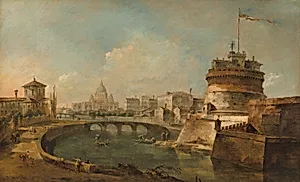
Fanciful View of the Castel Sant'Angelo, Rome
c. 1785
Medium
oil on canvas
Dimensions
overall: 46.8 x 76.3 cm (18 7/16 x 30 1/16 in.) framed: 63.7 x 91.8 x 7 cm (25 1/16 x 36 1/8 x 2 3/4 in.)
Classification
Painting
Department
CIS-B
Museum
National Gallery of Art, Washington, D.C.
Credit
Gift of Howard Sturges
Accession Number
1956.9.2
Rights
Public Domain
Art Historical Context
Francesco Guardi's "Fanciful View of the Castel Sant'Angelo, Rome," painted around 1785, captures the celebrated Roman landmark through the lens of an 18th-century Venetian master. Guardi, best known for his luminous cityscapes and capricci—imaginary compositions that blend real architecture with poetic invention—presents the ancient fortress, originally Hadrian’s Mausoleum, as a romantic silhouette against a softly glowing sky. The oil-on-canvas technique allows him to layer delicate glazes and loose brushwork, creating an atmospheric depth that feels both intimate and expansive despite the painting’s modest size. As a leading figure of the Venetian Rococo, Guardi infused his views with a sense of fleeting light and movement that distinguished him from more topographically precise contemporaries like Canaletto. This work reflects the era’s fascination with Italy among European travelers on the Grand Tour, transforming a familiar monument into an evocative, almost dreamlike scene. The fanciful arrangement of buildings and figures invites viewers to experience Rome not merely as a historical site, but as a place of memory and imagination. Today in the National Gallery of Art’s collection, the painting exemplifies Guardi’s late style and the enduring appeal of capricci as both souvenirs and works of pure artistry.
About the Artist
Francesco Guardi · 1712–1793
Francesco Lazzaro Guardi (1712–1793) was born into a noble family of painters from Trentino who had settled in Venice. His father, Domenico Guardi, a minor painter trained in Vienna, died in 1716, leaving young Francesco to inherit the family workshop alongside his brothers Giovanni Antonio (Gian Antonio) and Niccolò, both artists, and sister Maria Cecilia, who married the renowned Giovanni Battis...