
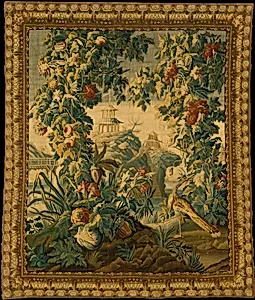
Fantastic Landscape
ca. 1725
Medium
Wool, silk (15-16 warps per inch, 6 per cm.)
Dimensions
8 ft. 8 in. × 90 in. (264.2 × 228.6 cm)
Classification
Textiles-Tapestries
Culture
French, Aubusson
Department
European Sculpture and Decorative Arts
Museum
Metropolitan Museum of Art, New York, NY
Credit
Gift of Alexander Smith Cochran, 1911
Accession Number
11.175.17
Rights
Public Domain
Tags
Art Historical Context
Created around 1725 in the renowned weaving center of Aubusson, France, this large wool-and-silk tapestry captures an enchanting “fantastic landscape” filled with vibrant flowers, graceful cranes, and other birds. Measuring over eight feet tall, the piece reflects the period’s taste for opulent wall hangings that brought nature’s exuberance indoors. Jacques Dorliac’s design exemplifies the light, decorative spirit of early-eighteenth-century French tapestry, where imaginary scenes offered viewers a delightful escape. Aubusson workshops were celebrated across Europe for their fine weaving—here using fifteen to sixteen warps per inch—and for adapting fashionable motifs drawn from contemporary prints and paintings. Such tapestries adorned the salons of aristocratic homes, signaling both wealth and refined taste while also providing practical insulation. The prominent cranes and floral garlands evoke themes of harmony and abundance popular in the Rococo era. Today, this work in the Metropolitan Museum’s collection reminds us how tapestries functioned as both art and architecture, transforming plain walls into lush, animated gardens that continue to delight visitors centuries later.