
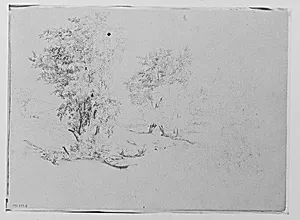
Stream Bank with Trees, Dinghy (from Sketchbook)
ca. 1860–ca. 1864
Medium
Graphite on green-tinted paper
Dimensions
9 3/4 x 13 7/8 in. (24.8 x 35.2 cm)
Classification
Drawing
Culture
American
Department
The American Wing
Museum
Metropolitan Museum of Art, New York, NY
Credit
Purchase, Sheila and Richard J. Schwartz Fund and Gifts in memory of Stephen D. Rubin, 1992
Accession Number
1992.373.4 recto
Rights
Public Domain
Tags
Art Historical Context
Thomas Hewes Hinckley’s “Stream Bank with Trees, Dinghy” offers a quiet glimpse into mid-nineteenth-century American landscape drawing. Created between 1860 and 1864 on green-tinted paper, this graphite sketch captures a tranquil riverside scene with trees lining the water’s edge and a small dinghy resting nearby. The tinted paper lends subtle depth, allowing the artist to build soft contrasts and atmospheric effects with economical strokes. As a page from a sketchbook, the drawing reflects the working practice of American artists who turned to nature for inspiration during a period of rapid national expansion and change. Hinckley’s economical handling of line suggests an on-site study, recording light, texture, and spatial relationships that may have informed later studio paintings. Such sketches were essential tools for developing an authentic sense of place. Today the work resides in the Metropolitan Museum’s American Wing, where it joins a rich collection documenting how artists interpreted the natural world in graphite, ink, and watercolor. Its modest scale and spontaneous quality invite viewers to appreciate the intimate process behind more finished landscapes of the era.
About the Artist
Thomas Hewes Hinckley · 1813–1896
Thomas Hewes Hinckley (1813–1896) was an American painter who became one of the leading specialists in animal painting in the United States during the mid-nineteenth century. Born in Milton, Massachusetts, he was largely self-taught in his early years, developing his skills through sustained observation of animals in the field and study of European masters whose work he encountered in reproduction...