
Farms
published in or before 1676
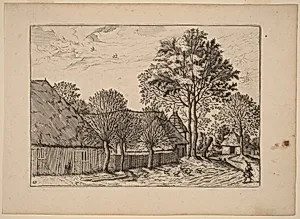
Medium
etching retouched with engraving
Dimensions
plate: 13 x 19 cm (5 1/8 x 7 1/2 in.) sheet: 17.5 x 24.1 cm (6 7/8 x 9 1/2 in.)
Classification
Department
CG-E
Museum
National Gallery of Art, Washington, D.C.
Credit
Ailsa Mellon Bruce Fund
Accession Number
1972.28.57
Rights
Public Domain
Art Historical Context
**Farms** is a delicate etching retouched with engraving by skilled Dutch brothers Johannes and Lucas van Dochum, created after the anonymous Master of the Small Landscapes. in or before 1676, this intimate print measures just 13 x 19 cm on the plate, rural Netherlandish farms in exquisite detail. Housed in the National Gallery Art's Prints department (acquired via the Ailsa Mellon Bruce Fund), it exemplifies the 16th-century Antwerp printmaking tradition, where the van Doetechums excelled at translating drawings into reproducible art. The Master of the Small Landscapes, active around 1550–60, pioneered a series of small-scale etchings that celebrated everyday countryside scenes—farms, villages, and winding paths—without relying on religious or mythological narratives. This shift marked a key moment in art history, elevating landscape as a standalone genre and influencing later masters like Rembrandt and the Dutch Golden Age painters. The van Doetechums' technique blended etching's fluid, spontaneous lines with engraving's precise burin work, achieving remarkable texture in foliage, thatch roofs, and distant horizons. For visitors, *Farms* offers a window into Renaissance Europe's fascination with the pastoral idyll, made accessible through affordable prints that spread these visions across homes and collections. Its modest size belies its big impact on how we visualize the harmonious beauty of rural life.