
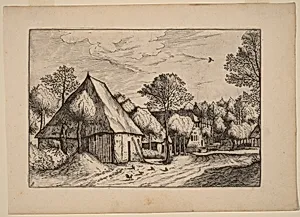
A Farmyard with a Draw Well
published in or before 1676
Medium
etching retouched with engraving
Dimensions
plate: 13.3 x 19.5 cm (5 1/4 x 7 11/16 in.) sheet: 17.4 x 24.1 cm (6 7/8 x 9 1/2 in.)
Classification
Department
CG-E
Museum
National Gallery of Art, Washington, D.C.
Credit
Ailsa Mellon Bruce Fund
Accession Number
1972.28.62
Rights
Public Domain
Art Historical Context
Step into a serene 16th-century Netherlandish farmyard with *A Farmyard with a Draw Well*, delicate print etched and engraved by the skilled brothers Johannes van Doeteum the Elder and Lucas van Dochum. Created after the anonymous Master of Small Landscapes—a pivotal figure in early landscape printmaking—this work captures everyday rural life: a sturdy draw well at center, flanked by thatched barns, wandering chickens, and distant hills under a vast sky. Published in or before 1676, it reflects the Doetechums' mastery in reproducing intricate designs from their era's innovative landscape tradition. The medium—etching retouched with engraving—highlights 16th-century printmaking prowess. Etching allowed fluid, spontaneous lines mimicking drawing, while engraving added precise details for texture and depth, making these small plates (just 13.3 x 19.5 cm) remarkably vivid. Part of the National Gallery of Art's collection (Ailsa Mellon Bruce Fund), it exemplifies how prints democratized art, bringing pastoral idylls to collectors beyond oil paintings. This piece underscores the cultural shift toward celebrating nature in Northern Renaissance art, evoking nostalgia for harmonious countryside living amid urbanization. A charming window into history, it invites you to linger on its tiny wonders.
About the Artist
Johannes van Doetechum, the Elder and Lucas van Doetechum after Master of the Small Landscapes
**Johannes van Doetechum the Elder and Lucas van Doetechum: Masters of the Small Landscapes** Johannes van Doetechum the Elder, born around 1530 in Deventer in the northern Netherlands, and his brother Lucas, active from 1554, formed one of the most prolific engraving teams of the 16th-century Netherlandish Renaissance. Hailing from a family of printmakers—Johannes was the son of Jan ter Heghe an...