
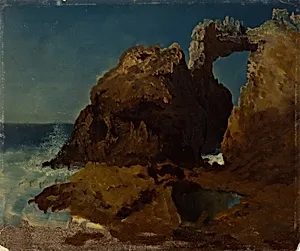
Farralones Islands, Pacific Ocean
Classification
Painting
Department
Smithsonian Collection
Museum
Smithsonian American Art Museum
Credit
Hirshhorn Museum and Sculpture Garden, Smithsonian Institution, Washington, DC, Gift of Joseph H. Hirshhorn, 1966
Accession Number
66.505
Rights
Public Domain
About this artwork
Parke-Bernet Galleries, New York, to 1964
Art Historical Context
Albert Bierstadt (1830–1902), a German-born American painter and luminist master of the Hudson River School immortalized the remote Farallon Islands in this 1872 painting. Perched 28 miles off San Francisco in the Pacific Ocean, these jagged granite outcrops—famed for their treacherous waters, seabird colonies, and guano deposits—embody the untamed wilderness that captivated 19th-century explorers and artists. Bierstadt, who journeyed extensively through the American West and California, rendered their dramatic isolation with romantic grandeur, evoking nature's sublime power amid post-Civil War national expansion. True to his style, Bierstadt likely employed meticulous brushwork to contrast craggy foreground rocks against hazy, luminous skies and churning seas, using light effects to heighten emotional awe. His panoramic vistas not only showcased technical virtuosity—blending realism with idealism—but also promoted conservation ideals, influencing the push for protected landscapes like Yosemite. Now in the Smithsonian American Art Museum's collection, this work entered via the Hirshhorn Museum and Sculpture Garden as a 1966 gift from Joseph H. Hirshhorn. Previously sold through New York’s Parke-Bernet Galleries, it reflects Bierstadt's enduring legacy in celebrating America's natural frontiers.