
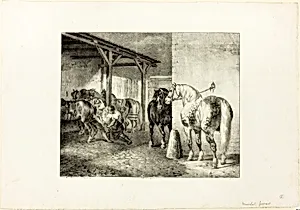
Farrier's Shop
Medium
Lithograph in black on ivory wove paper
Dimensions
Image: 20.3 × 25.2 cm (8 × 9 15/16 in.); Sheet: 29.4 × 42 cm (11 5/8 × 16 9/16 in.)
Classification
lithograph
Department
Prints and Drawings
Museum
Art Institute of Chicago
Accession Number
79486
Rights
Public Domain
Art Historical Context
Jean Louis André Théodore Géricault created *Farrier’s Shop* in 1823, near the end of his brief but influential career. Best known as a leading figure of French Romanticism, Géricault often explored themes of human struggle, movement, and the natural world, frequently featuring horses in his work. This lithograph captures a humble blacksmith’s workshop, where the farrier tends to horses—an everyday scene rendered with the dramatic energy and keen observation that characterize his style. The choice of lithography is significant. Invented only a few decades earlier, the medium allowed artists to draw directly on stone with fluid, expressive lines that could be reproduced in multiple impressions. Géricault embraced lithography’s bold contrasts and spontaneous quality to convey texture, light, and motion, bringing vitality to the print’s black-and-white composition on ivory wove paper. Today in the collection of the Art Institute of Chicago, this work reflects both the technical innovations of early nineteenth-century printmaking and Géricault’s interest in ordinary subjects infused with Romantic intensity. Its modest scale invites close looking, revealing the artist’s skill in transforming a routine scene into something dynamic and alive.
About the Artist
Jean Louis André Théodore Géricault · 1791–1824
Jean-Louis André Théodore Géricault (1791–1824) was born into a prosperous bourgeois family in Rouen, France, the son of a lawyer who managed the family tobacco business. After moving to Paris around 1797, his artistic talent emerged early, nurtured in a circle that included his maternal uncle Jean-Baptiste Caruel and art dealer Jean-Louis Laneuville. Géricault began formal training in 1808 under ...