
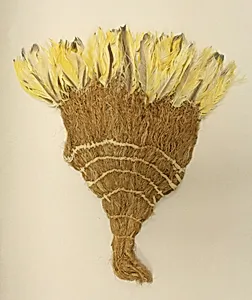
Feathered Ornament
Unknown Artist
11th–15th century (?)
Medium
Feathers, vegetable fiber, cotton
Dimensions
H. 11 x W. 9 1/2 in. (27.9 x 24.1 cm)
Classification
Feathers-Ornaments
Culture
Central or south coast (?)
Department
Arts of Africa, Oceania, and the Americas
Museum
Metropolitan Museum of Art, New York, NY
Credit
The Michael C. Rockefeller Memorial Collection, Gift of Miss Amalia M. de Schulthess, 1960
Accession Number
1978.412.47
Rights
Public Domain
Art Historical Context
This delicate *Feathered Ornament*, crafted between the 11th and 15th centuries, exemplifies the masterful featherwork of pre-Columbian cultures from Peru's central or south coast. Measuring just 11 x 9½ inches (27.9 x 24.1 cm), it was fashioned from vibrant feathers meticulously attached to a base of vegetable fiber and cotton—a technique that highlights the artisans' skill in preserving ephemeral materials over centuries. Such ornaments were likely prestige items, adorning headdresses or garments during rituals, where feathers symbolized spiritual power and connection to the natural world. In the context of Andean societies, featherwork represented technical innovation and cultural reverence for avian motifs, often sourced from tropical birds prized for their iridescent hues. Though the exact culture remains uncertain, pieces like this from the Chimú or Chancay spheres underscore a thriving tradition of lightweight, colorful textiles that contrasted with heavier gold or ceramic arts. Today, housed in The Metropolitan Museum of Art's Michael C. Rockefeller Memorial Collection (gift of Amalia M. de Schulthess, 1960), it offers a glimpse into the ingenuity of ancient American artists, bridging artistry and cosmology.