
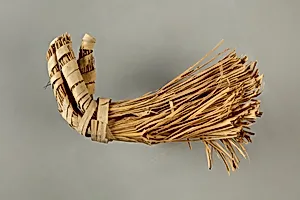
Brush
Unknown Artist
664 B.C. or later
Medium
Grass, palm leaf
Dimensions
L. 21.3 × W. 17 cm (8 3/8 × 6 11/16 in.)
Classification
Plants, brush, tool
Period
Late Period or later
Department
Egyptian Art
Museum
Metropolitan Museum of Art, New York, NY
Credit
Rogers Fund, 1931
Accession Number
31.3.132
Rights
Public Domain
Art Historical Context
This unassuming yet remarkable "Brush" from ancient, dating to 664 B.C. or during the Late Period, offers a glimpse into the everyday tools of scribes and artists. Crafted from humble grass and palm leaf—natural materials abundant in the Nile Valley—it measures a compact 21.3 × 17 cm, perfectly suited for precise work on papyrus or other surfaces. Acquired through the Rogers Fund in 1, it now resides in the Metropolitan Museum of Art's Egyptian Art collection. In the Late Period (c. 664–332 B.C.), Egypt saw political shifts under native pharaohs and foreign rulers, yet cultural traditions like hieroglyphic writing thrived. Brushes like this were essential for inscribing sacred texts, administrative records, and artistic scenes, often paired with ink made from soot or ochre. The use of plant fibers reflects Egyptian ingenuity, binding tough palm strips with grass for durability and flexibility, allowing fluid strokes that brought monumental art and literature to life. Though simple, this artifact underscores the cultural backbone of ancient Egypt: writing as a divine craft linking gods, kings, and common folk. It reminds us how ordinary objects fueled one of history's greatest civilizations, bridging utility and artistry in ways that resonate across millennia.