
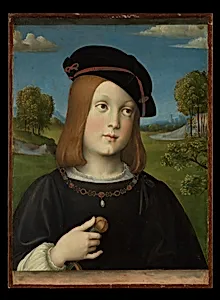
Federico Gonzaga (1500–1540)
Medium
Tempera on wood, transferred from wood to canvas and then again to wood
Dimensions
Overall 18 7/8 x 14 in. (47.9 x 35.6 cm); painted surface 17 3/4 x 13 1/2 in. (45.1 x 34.3 cm)
Classification
Paintings
Department
European Paintings
Museum
Metropolitan Museum of Art, New York, NY
Credit
Bequest of Benjamin Altman, 1913
Accession Number
14.40.638
Rights
Public Domain
Tags
Art Historical Context
In the early 16th century, Francesco Francia, a leading painter of the Bolognese school, captured the youthful poise of Federico Gonzaga this intimate portrait from 1510. At just 10 years old, Federicofuture Duke of Mantua and a key patron of the Renaissance—was depicted with the refined elegance typical of Francia's style, blending Northern Italian clarity with influences from Perugino. This work exemplifies the Renaissance fascination with individualized portraiture, showcasing the boy's noble status through his direct gaze, luxurious attire, and subtle modeling that conveys both innocence and promise. Painted in tempera on wood—a meticulous egg-based medium prized for its luminous detail and durability—this panel (18⅞ × 14 inches) has undergone careful conservation, transferred first to canvas and then back to wood to preserve its delicate surface. The technique allowed Francia to achieve finely graduated tones and a jewel-like quality, highlighting the cultural importance of such portraits in affirming dynastic legacies among Italy's ruling families like the Gonzaga. Today, housed in the Metropolitan Museum of Art thanks to the 1913 bequest of Benjamin Altman, this painting offers visitors a window into the vibrant courts of Renaissance Italy, where art immortalized the heirs of power.
About the Artist
Francesco Francia · 1447–1517
Influential Bolognese painter of his period, noted for sweet, softly rounded Madonnas and portraits. Influenced by Costa, his partner, and by Perugino. Comment on works: Religious