
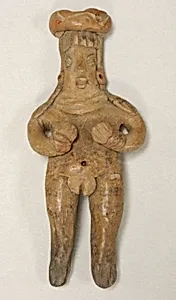
Female Figure
Unknown Artist
3rd century BCE–4th century CE
Medium
Ceramic, pigment
Dimensions
H. 3 3/16 in. (8.2 cm)
Classification
Ceramics-Sculpture
Culture
Chupicuaro
Department
Arts of Africa, Oceania, and the Americas
Museum
Metropolitan Museum of Art, New York, NY
Credit
The Michael C. Rockefeller Memorial Collection, Bequest of Nelson A. Rockefeller, 1979
Accession Number
1979.206.992
Rights
Public Domain
Tags
Art Historical Context
This delicate ceramic Female Figure hails from the Chupícuaro culture of west-central Mexico, dating to the 3rd century BCE through 4th century CE. Standing just 3 3/16 inches (8.2 cm) tall, it exemplifies the Pre-Columbian tradition of small-scale figurines crafted by an unknown artist. Made from ceramic with applied pigments, the piece reflects the Chupícuaro people's skill in hand-building and decorating pottery, often using slips and paints to enhance naturalistic forms. These intimate sculptures were likely produced for household rituals, offerings, or personal devotion. Chupícuaro art is renowned for its stylized human figures, particularly females depicted in nude or minimally adorned poses, suggesting themes of fertility, ancestry, or spiritual guardianship. The use of pigment adds vivid color and detail, highlighting features like elongated limbs and expressive faces that convey a sense of quiet vitality. Though modest in size, such works reveal a sophisticated aesthetic from a culture bridging early Mesoamerican horizons. Now part of The Michael C. Rockefeller Memorial Collection at The Metropolitan Museum of Art, this figure invites us to ponder the daily lives and beliefs of ancient Chupícuaro communities, where art intertwined with the sacred and everyday.