
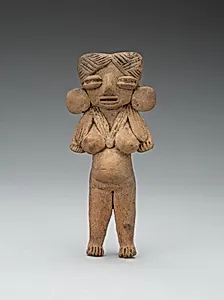
Female Figure
500–300 BCE
Medium
Earthenware and pigment
Dimensions
12.2 × 5.2 × 3.6 cm (4 13/16 × 2 1/16 × 1 7/16 in.)
Classification
earthenware
Department
Arts of the Americas
Museum
Art Institute of Chicago
Accession Number
120519
Rights
Public Domain
Art Historical Context
This small yet expressive Female Figure, crafted by artisans of the Chupícuaro culture between 500 and 300 BCE, offers a window into the artistic traditions of ancient west-central Mexico. Standing just over four inches tall, the earthenware sculpture was formed by hand and enhanced with pigment, a technique that allowed the Chupícuaro people to create durable, vividly colored works intended for ritual or funerary use. Such figures often accompanied the deceased, suggesting they held deep spiritual significance as companions or symbols of fertility and continuity. Chupícuaro ceramics are celebrated for their elegant simplicity and attention to the human form, with this example emphasizing the female body through subtle modeling and painted details. Created during the Late Formative period, these objects reflect a society that valued both technical skill and symbolic expression, bridging everyday life with the sacred. Today, the piece resides in the Art Institute of Chicago’s Arts of the Americas collection, where it connects modern viewers to the rich cultural heritage of Mesoamerica’s early ceramic traditions.