
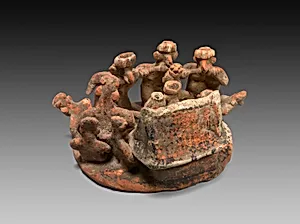
Funerary Cheek-Piercing Ritual
200 BCE–300 CE
Medium
Earthenware and pigment
Dimensions
12.3 × 25 × 20.8 cm (4 7/8 × 9 7/8 × 8 1/4 in.)
Classification
earthenware
Department
Arts of the Americas
Museum
Art Institute of Chicago
Accession Number
148347
Rights
Public Domain
Art Historical Context
This striking earthenware sculpture from ancient Nayarit, created between 200 BCE and 300 CE, captures a dramatic moment in a funerary cheek-piercing ritual. Produced in the western Mexican region known for its elaborate shaft-tomb burials, the work likely served as a grave offering, illustrating ceremonial practices that honored the deceased and connected the living with ancestral spirits. The compact yet expressive form, measuring just over 12 centimeters in height, suggests it was designed to accompany the dead into the afterlife. Crafted from fired clay and enhanced with pigment, the piece reflects the sophisticated ceramic traditions of Nayarit artists. These potters often modeled lively scenes of rituals, ballgames, and daily life, using hand-building techniques to create dynamic compositions that convey movement and emotion. The choice of medium allowed for durable, vividly painted surfaces that have preserved glimpses of Pre-Columbian spiritual beliefs. Today housed in the Art Institute of Chicago’s Arts of the Americas collection, this object offers valuable insight into the cultural importance of body modification and communal rites in ancient West Mexico. Its detailed depiction invites viewers to consider how such ceremonies reinforced social bonds and marked transitions between life and death.