
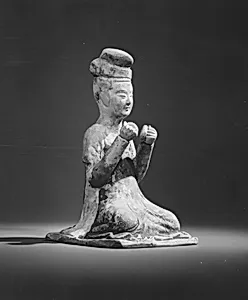
唐 彩繪陶樂伎女俑|Female musician
Unknown Artist
late 7th century
Medium
Earthenware with pigment
Dimensions
H. 5 3/4 in. (14.6 cm); W. 3 1/2 in. (8.9 cm); D. 3 1/8 in. (8.6 cm)
Classification
Tomb Pottery
Culture & Period
China · Tang dynasty (618–907)
Department
Asian Art
Museum
Metropolitan Museum of Art, New York, NY
Credit
Rogers Fund, 1923
Accession Number
23.180.5
Rights
Public Domain
Tags
Art Historical Context
This enchanting earthenware figurine, titled *Female Musician*, hails from the Tang dynasty (618–907), a golden era of Chinese prosperity and cultural flourishing. Crafted in the late 7th century, it exemplifies *mingqi*—tomb pottery placed in burials to accompany the deceased into the afterlife, providing entertainment and services in the spiritual realm. Standing just 5 3/4 inches tall, this lively depiction of a female musician (le ji) captures the cosmopolitan vibrancy of Tang society, where women often performed in courts and households, reflecting the era's openness to music, dance, and foreign influences along the Silk Road. The artwork's medium—low-fired earthenware coated in vivid pigments—highlights Tang artisans' mastery of polychrome ceramics, which brought sculptures to life with bright reds, greens, and blacks. Traces of these colors emphasize the figure's graceful pose, flowing robes, and musical attributes, suggesting she once held an instrument like a pipa or flute. Such detailed tomb figures not only served funerary purposes but also offer modern viewers a window into daily life, gender roles, and the Tang's artistic realism. On view in the Metropolitan Museum of Art's Asian Art department (Rogers Fund, 1923), this petite treasure invites us to imagine the melodies echoing through ancient palaces, bridging 1,300 years of human creativity.