
Female Portrait (Weibliches Bildnis)
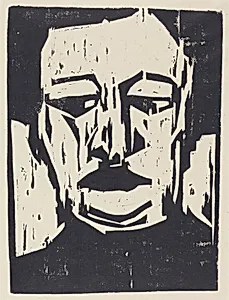
Medium
woodcut in black on cream laid paper
Dimensions
image: 24 x 17.3 cm (9 7/16 x 6 13/16 in.) sheet: 59.8 x 46.8 cm (23 9/16 x 18 7/16 in.)
Classification
Department
CG-W
Museum
National Gallery of Art, Washington, D.C.
Credit
Gift of Dr. Ruth Ivor
Accession Number
1993.73.2
Rights
Public Domain
Art Historical Context
**Female Portrait (Weiblichesnis)** by Karl Schmidt-Rottuff, created in 1909, the raw energy of German Expressionism during its formative. Schmidt-Rottluff, a founding member of the revolutionary artist group Die Brücke ( Bridge), formed in Dresden in 1905, sought to break from academic traditions. This woodcut reflects the group's embrace of primal, emotional expression, drawing inspiration from African and Oceanic art, medieval woodcuts, and folk traditions to convey inner truths over outward realism. Printed in bold black ink on cream laid paper, the work exemplifies the Expressionists' mastery of woodcut—a demanding relief printing technique where the artist carves away negative space from a wood block, leaving stark, jagged lines that pulse with vitality. Measuring 24 x 17.3 cm in its image area on a larger 59.8 x 46.8 cm sheet, the intimate scale invites close viewing, revealing simplified forms and angular contours that distill the female subject's essence into a powerful, almost totemic presence. Woodcuts were prized by Die Brücke for their affordability and directness, democratizing art in an era of social upheaval before World War I. Now housed in the National Gallery of Art as a gift from Dr. Ruth Ivor (Department CG-W, Classification: Print), this piece highlights Schmidt-Rottluff's pivotal role in modern printmaking, bridging Expressionism's emotional intensity with technical innovation for lasting cultural impact.
About the Artist
Karl Schmidt-Rottluff · 1884–1976
Karl Schmidt-Rottluff (1884–1976) was a German painter and printmaker who was a co-founder of Die Brücke (The Bridge), one of the most important groups of the Expressionist movement. Born Karl Schmidt in Rottluff near Chemnitz, he adopted his birthplace as a surname and in 1905, together with Ernst Ludwig Kirchner, Fritz Bleyl, and Erich Heckel, founded Die Brücke in Dresden, a group dedicated to ...