
Female Saint (Barbara?)
c. 1500 - c. 1525
Medium
oak with polychromy
Dimensions
10.5; 44; 15
Rights
Public Domain
About this artwork
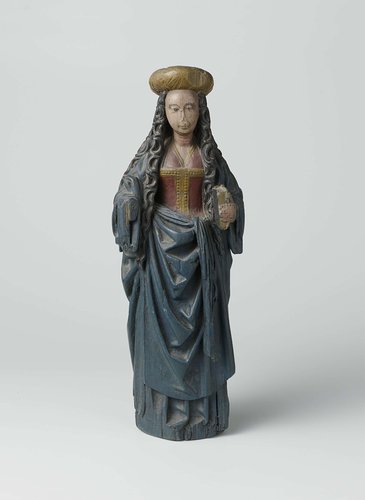
Zij houdt een boek in de linkerhand. Over een hemd draagt ze een laag uitgesneden keurs, verder een rok en een mantel. Om het middel een sjerp. Op het lange, golvende haar een tulband.
Art Historical Context
This exquisite wooden sculpture, titled *Female Saint (Barbara?)*, dates to around 1500–1525 and exemplifies the craftsmanship of anonymous Northern European artists during the transition from Late Gothic to early Renaissance styles. Carved from oak and enhanced with polychromy—vibrant paints and gilding that once brought the figure vividly to life—this small devotional statue (44 cm tall) was likely created for private prayer or a church altar. Its intimate scale invited personal devotion, a common feature in 16th-century Low Countries workshops. The saint stands gracefully, clutching a book in her left hand—a symbol often associated with learned female saints like Barbara, patroness of miners and artillerymen. She wears a chemise beneath a low-cut bodice, paired with a flowing skirt, mantle, waist sash, and a striking turban over long, wavy hair. These details reflect contemporary fashion with an exotic flair, showcasing the sculptor's skill in rendering delicate fabrics, jewelry, and expressive features through careful undercutting and layered polychrome finishes. Such works highlight the era's religious fervor, where polychromed wood allowed saints to seem miraculously present. Though attribution is lost to time, this piece endures as a window into daily spirituality, blending piety with artistic elegance.
About the Artist
anonymous
In the vast tapestry of art history, "Anonymous" stands not as a singular individual but as a collective designation for countless unidentified creators whose works have endured across millennia. These artists, spanning prehistoric cave painters to medieval illuminators and folk craftsmen, produced the foundational layers of human visual culture. Prior to the Renaissance, when individual fame emer...