
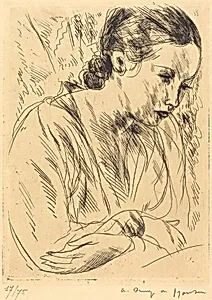
Fernande with Arms Crossed, Large Plate (Fernande les mains croisees (grande planche)
Medium
etching
Classification
Department
CG-W
Museum
National Gallery of Art, Washington, D.C.
Credit
Frank Crowninshield Collection
Accession Number
1948.3.67
Rights
Public Domain
Art Historical Context
In the bustling Paris art scene of the 1920s, André Dunoyer de Segonz captured the poised elegance of his sitter in *Fernande with Arms Cross, Large Plate* (3), a masterful etching from the National Gallery of Art's Frank Crowninshield Collection Segonzac, a prominent French artist of the School of Paris, blended classical realism with a modern flair, influenced by his experiences in World War I trenches and the vibrant interwar cultural milieu. This large-plate etching showcases his precise line work, where acid-etched grooves on a metal plate create rich, tonal depth and subtle textures upon printing— a technique that allowed for intimate, reproducible portraits amid the era's fascination with celebrity and bohemia. The subject, Fernande—likely Fernande Olivier, the iconic muse of Picasso's early Cubist years—stands with arms defiantly crossed, exuding quiet strength and introspection. Segonzac's etching immortalizes her post-Picasso allure, transforming a personal moment into a universal study of poise and resilience. As a print, it democratized access to fine art, reflecting the 1920s shift toward graphic innovation while honoring traditional draftsmanship. Housed in the NGA's prints department (CG-W), this work highlights Segonzac's versatility across painting, drawing, and engraving, offering visitors a window into the human stories behind Paris's golden age.
About the Artist
André Dunoyer de Segonzac
André Dunoyer de Segonzac (1884–1974) was a leading French painter, draughtsman, engraver, and illustrator, born on 6 July in Boussy-Saint-Antoine near Paris, where he spent much of his childhood alongside time in the city. Defying his parents' initial hopes for a military career at Saint-Cyr, he pursued art, enrolling in 1900 at the École des Beaux-Arts in Paris as a general student. He studied u...