
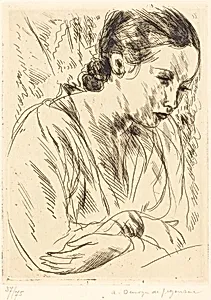
Fernande with Arms Crossed, Large Plate (Fernande les mains croisees (grande planche)
Medium
etching
Classification
Department
CG-W
Museum
National Gallery of Art, Washington, D.C.
Credit
Frank Crowninshield Collection
Accession Number
1948.3.68
Rights
Public Domain
Art Historical Context
**Fernande with Arms Cross, Large Plate (Fernande les mains croes (grande planche *André Dunoyer de Segonz, 1923, etching* *National Gallery of Art Frank Crowninshield CollectionCreated in 1923, this etching captures the poised figure of Fernande with her arms crossed, a composition that exemplifies André Dunoyer de Segonz's mastery of the print medium during the vibrant interwar Paris art scene. Segonzac, a leading French artist of the School of Paris, was renowned for his precise draughtsmanship and elegant line work, blending classical realism with modern sensibilities. His prints often drew from everyday subjects, infusing them with a sense of immediacy and sophistication reflective of the Roaring Twenties' cultural dynamism. Etching, an intaglio technique where acid etches intricate lines into a metal plate, allowed Segonzac to achieve remarkable depth and texture. The "large plate" format here emphasizes the subject's contemplative stance, highlighting his skill in rendering form through subtle tonal variations and fluid contours. This work, part of the Frank Crowninshield Collection at the National Gallery of Art, showcases the enduring appeal of early 20th-century French printmaking, bridging intimate portraiture with technical innovation. Visitors will appreciate how Segonzac's etching invites close inspection, revealing the artist's keen observation of human gesture amid the era's artistic experimentation. A testament to the golden age of graphic arts, it remains a captivating study in poise and precision.
About the Artist
André Dunoyer de Segonzac
André Dunoyer de Segonzac (1884–1974) was a leading French painter, draughtsman, engraver, and illustrator, born on 6 July in Boussy-Saint-Antoine near Paris, where he spent much of his childhood alongside time in the city. Defying his parents' initial hopes for a military career at Saint-Cyr, he pursued art, enrolling in 1900 at the École des Beaux-Arts in Paris as a general student. He studied u...