
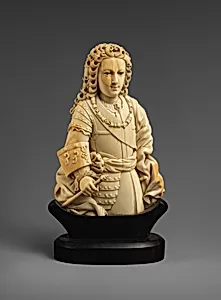
Fernando VI of Spain
Unknown Artist
18th century
Medium
Ivory, on curved ebony base
Dimensions
figure only, confirmed: 7 × 4 5/8 × 1 3/8 in. (17.8 × 11.7 × 3.5 cm) on base, confirmed: 8 13/16 × 4 7/8 × 2 5/8 in. (22.4 × 12.4 × 6.7 cm)
Classification
Sculpture-Miniature
Culture
Chinese or Philippine
Department
European Sculpture and Decorative Arts
Museum
Metropolitan Museum of Art, New York, NY
Credit
Gift of Alfred and Victoria Harris, 1975
Accession Number
1975.433.1
Rights
Public Domain
Tags
Art Historical Context
This exquisite miniature ivory sculpture depicts Fernando VI, King of Spain from 1746 to 1759, crafted by an unknown artist in 18th century. Standing just 7 inches tall (with base), it exemplifies the intricate artistry of Chinese or Philippine ivory carvers, who were renowned for producing finely detailed portrait figures for European markets. The smooth, polished ivory captures the king's regal posture and attire, while the curved ebony base elegant stability and contrast, highlighting the sculptor's mastery of miniature scale. Ivory carving flourished in these regions during the height of global trade, particularly via the Manila galleons linking Asia, the Americas, and Europe. Such works often portrayed foreign dignitaries as luxury curiosities, blending Eastern technical precision—evident in the delicate facial features and folds of clothing—with Western iconography. This piece reflects the cultural exchanges of the Enlightenment era, when exotic materials like ivory and ebony symbolized wealth and sophistication in European decorative arts. Housed in the Metropolitan Museum of Art's Department of European Sculpture and Decorative Arts (gift of Alfred and Victoria Harris, 1975), it invites visitors to ponder the interconnected world of 18th-century craftsmanship, where a Spanish monarch's likeness emerged from distant shores.