
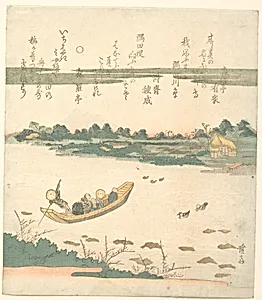
Ferry Boat Crossing the Sumida River
ca. 1840
Medium
Woodblock print (surimono); ink and color on paper
Dimensions
8 3/8 x 7 1/4 in. (21.3 x 18.4 cm)
Classification
Prints
Culture & Period
Japan · Edo period (1615–1868)
Department
Asian Art
Museum
Metropolitan Museum of Art, New York, NY
Credit
The Howard Mansfield Collection, Purchase, Rogers Fund, 1936
Accession Number
JP2742
Rights
Public Domain
Tags
Art Historical Context
This captivating woodblock print by Keisai Eisen invites viewers into a serene moment on the Sumida River during Japan’s Edo period. Created around 1840 as a surimono—a privately commissioned print often featuring poetry and fine details—the work showcases Eisen’s skill in capturing everyday scenes with elegance. Measuring just over eight inches wide, the compact format highlights the intimate nature of surimono, which were typically exchanged among friends or literary circles rather than sold publicly. Eisen, active in the vibrant ukiyo-e tradition, depicts a ferry boat carrying passengers and animals across the river, a vital artery of life in Edo (modern-day Tokyo). The scene reflects the period’s fascination with travel and urban waterways, rendered through delicate ink lines and subtle color washes on paper. Such prints celebrated the transient beauty of daily existence, blending human activity with the natural flow of the river. As part of the Metropolitan Museum’s Asian Art collection, this piece offers a glimpse into 19th-century Japanese printmaking techniques and the cultural importance of the Sumida as both a practical route and a poetic subject. Its refined execution underscores the high artistry of even small-scale works from this era.
About the Artist
Keisai Eisen · 1790–1848
Keisai Eisen (1790–1848), born Ikeda Yoshinobu in Edo (modern Tokyo), emerged as one of the late Edo period's most prolific ukiyo-e masters. The son of the renowned calligrapher and Kanō-school painter Ikeda Shigeharu, Eisen was immersed in the arts from childhood. He apprenticed under Kanō Hakkeisai, adopting the art name "Keisai" in homage to his teacher, and later studied bijin-ga (images of be...