
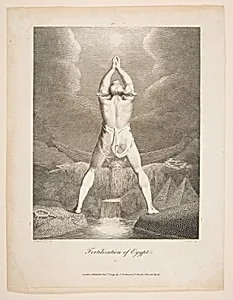
Fertilization of Egypt, from Erasmus Darwin's "The Botanic Garden"
Medium
Engraving
Dimensions
image: 7 5/8 x 6 in. (19.4 x 15.2 cm) sheet: 10 1/8 x 7 13/16 in. (25.7 x 19.8 cm)
Classification
Prints
Department
Drawings and Prints
Museum
Metropolitan Museum of Art, New York, NY
Credit
The Elisha Whittelsey Collection, The Elisha Whittelsey Fund, 1968
Accession Number
68.540.10
Rights
Public Domain
Art Historical Context
In the lush poetic world of Erasmus Darwin's *The Bot Garden* (1791), the engraving *Fertilization of* vividly captures a metaphorical scene from the poem's second part, *The Loves of the Plants*. Darwin, a pioneering physician, naturalist, and grandfather of Charles Darwin, used botanical allegory to explore themes of science, evolution, and human progress during the Enlightenment. Here, the Nile's life-giving floods symbolize renewal and fertility, blending classical mythology with emerging scientific ideas in a Romantic fervor. Designed by the dramatic Swiss-born artist Henry Fuseli and masterfully engraved by William Blake, this intricate print exemplifies early Romantic visual poetry. Fuseli's bold, theatrical style—known from works like *The Nightmare*—infuses the scene with dynamic energy and exotic grandeur, while Blake's precise engraving technique, using fine lines on a copper plate, allowed for rich tonal contrasts and multiple impressions. Measuring just 7 5/8 x 6 inches, its small scale belies the monumental themes of nature's power. Housed in the Metropolitan Museum of Art's Prints collection, this 1791 work highlights the interdisciplinary collaboration between literature, science, and art at the dawn of Romanticism. It offers visitors a window into how 18th-century intellectuals like Darwin envisioned humanity's harmony with the natural world, foreshadowing bolder evolutionary narratives to come.
About the Artist
Erasmus Darwin|William Blake|Henry Fuseli (British|British|Swiss) · 1731 |1757 |1741 –1802 |1827 |1825
British, 1731–1802|British, London 1757–1827 London|Swiss, Zürich 1741–1825 London