
Fibula (leech type)
Geometric Period (800–700 BCE)
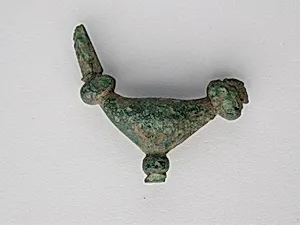
Medium
Bronze
Dimensions
4 × 4.4 × 1.2 cm (1 5/8 × 1 3/4 × 1/2 in.)
Classification
votive offering
Department
Arts of Greece, Rome, and Byzantium
Museum
Art Institute of Chicago
Accession Number
196465
Rights
Public Domain
About this artwork
This precious bronze object is a votive, or devotional gift, made as an offering to the gods. They come in many forms, such as animals, beads and brooches. Many seem once to have been attached to something else. Votives were hung from sacred trees or placed in sanctuaries around Greece. Once a shrine was full, the votives were ceremonially buried to make room for more offerings.
Art Historical Context
This delicate bronze fibula, or brooch, from Greece's Geometric Period (800700 BCE), exemplifies the's masterful metalworking and emerging artistic sophistication. Shaped in the distinctive "leech" form—resembling the segmented body of a leech—it measures just 4 × 4.4 × 1.2 cm, small enough to fasten a garment yet intricately crafted. Fibulae like this were essential accessories in daily life, securing cloaks and tunics, but this one served as a votive offering, dedicated to deities in a sanctuary as a token of gratitude or supplication. The Geometric Period marked Greece's recovery from the Bronze Age collapse, with art shifting toward abstract patterns and stylized motifs on pottery, jewelry, and bronzes. Bronze, an alloy of copper and tin, was prized for its durability and sheen, cast and hammered here into a functional yet ornamental piece. Such votives reveal intimate glimpses into ancient piety, where everyday objects became sacred bridges to the divine. Housed in the Art Institute of Chicago's Arts of Greece, Rome, and Byzantium department, this fibula highlights how personal devotion fueled artistic innovation, bridging utility and ritual in early Greek society.
About the Artist
Ancient Greek
The artist known simply as "Ancient Greek" represents the anonymous masters of Attic vase painting, a cornerstone of Classical Greek art from the Archaic and Classical periods (circa 700–300 BCE). Little is known of their personal life, as ancient Greek potters and painters rarely signed their works or left biographical traces; early life and training remain not well documented. These creators ope...