
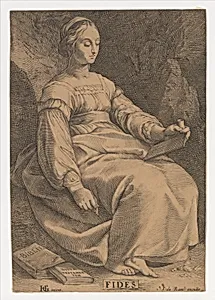
Fides (copy)
late 17th century
Medium
Engraving
Dimensions
sheet: 9 3/16 x 6 3/8 in. (23.4 x 16.2 cm)
Classification
Prints
Department
Drawings and Prints
Museum
Metropolitan Museum of Art, New York, NY
Credit
Harris Brisbane Dick Fund, 1953
Accession Number
53.601.336(75)
Rights
Public Domain
Tags
Art Historical Context
Welcome to the Metropolitan Museum of Art's Drawings and Prints department, where you'll find *Fides (copy)*, a delicate late 17th-century measuring 9 3/16 x 6 3/8 inches. This work is attributed to Hendrick Goltzius, the renowned Dutch Mannerist engraver, with copying contributions from Joannes de Ram or anonymous Dutch artist of the period. "Fides," for "Faith," likely depicts the allegorical female figure of this virtue—a common motif in Northern European art symbolizing devotion and loyalty, often portrayed with symbolic attributes like a chalice or palm. Engravings like this were revolutionary in the 17th century, allowing intricate designs to be mass-reproduced on paper for wider audiences beyond the elite. Goltzius, a master of the burin (the engraver's tool), was celebrated for his dynamic lines and muscular forms influenced by Italian Mannerism, which this copy echoes. Produced in the Dutch Golden Age, such prints bridged religious iconography and secular collecting, reflecting the era's fascination with classical virtues amid Protestant Reformation debates. Acquired through the Harris Brisbane Dick Fund in 1953, this piece highlights the Met's commitment to preserving reproductive prints that democratized art. Gaze closely at the fine hatching and cross-hatching techniques, which create depth and texture on the modest sheet—testaments to the enduring skill of Dutch printmakers.
About the Artist
Hendrick Goltzius|Joannes de Ram|Anonymous, Dutch, 17th century · 1558–1617
Hendrick Goltzius (1558–1617) was the most celebrated engraver of the Northern Renaissance and a pivotal figure in Dutch Mannerism. Born near the German-Dutch border, Goltzius transformed printmaking into a virtuoso art form through his revolutionary 'swelling line' technique, where the burin was manipulated to create lines of varying thickness that produced unprecedented tonal effects and three-d...