
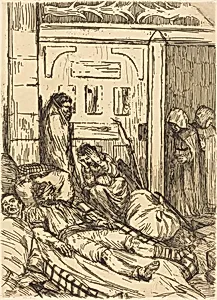
Field Hospital (L'ambulance)
1826 to 1850
Medium
etching
Classification
Department
CG-E
Museum
National Gallery of Art, Washington, D.C.
Credit
Rosenwald Collection
Accession Number
1943.3.5371
Rights
Public Domain
Art Historical Context
Alphonse Legros, a French-born artist who later became a prominent figure British art circles, created *Field Hospital (L'ambance)* as an etching during the mid19th century (ca. 1826–1850). This print captures the somber reality of wartime medical care, reflecting the era's growing awareness of military suffering amid conflicts like the Napoleonic aftermath and early modern wars. Legros, influenced by Realism, used etching—a meticulous intaglio technique where acid etches lines into a metal plate—to produce intricate, reproducible images that conveyed raw human drama with unflinching detail. Etchings like this one were revolutionary for their accessibility, allowing Legros to disseminate poignant social commentary beyond elite patrons. Housed in the National Gallery of Art's Rosenwald Collection (Department CG-E), the work exemplifies 19th-century printmaking's role in documenting humanitarian crises. Its stark portrayal of injured soldiers and caregivers underscores the cultural shift toward empathy for the wounded, blending technical precision with emotional depth to engage viewers in the human cost of war. A testament to Legros's versatility, it invites us to reflect on resilience amid adversity.
About the Artist
Alphonse Legros · 1837–1911
Alphonse Legros (1837–1911) was born in Dijon, France, and trained in Paris at the drawing school of Horace Lecoq de Boisbaudran, whose unconventional teaching method — which emphasised memory drawing and acute observation over academic convention — would leave a lasting mark on Legros's practice. At Lecoq's school he formed friendships with Jules Dalou and Auguste Rodin that endured throughout hi...