
Fiet van Stolk-Van der Does de Willebois
1918
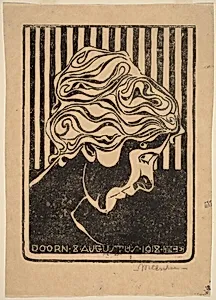
Medium
linoleum cut
Classification
Department
CG-W
Museum
National Gallery of Art, Washington, D.C.
Credit
Seymour and Iris Schwartz Collection
Accession Number
1978.90.27
Rights
Public Domain
Art Historical Context
Created in 1918, *Fiet van Stolk-Van der Does de Willebois* represents an early work by M.C. Escher, produced when the Dutch artist was just twenty years old. At this stage of his career, Escher was exploring traditional printmaking techniques before developing the intricate mathematical imagery for which he later became renowned. The portrait captures a quiet, personal moment, reflecting the artist’s initial focus on figurative subjects and careful observation. Executed as a linoleum cut, the print highlights the medium’s distinctive qualities. Linoleum, a relatively new material at the time, allowed artists to carve bold, fluid lines with greater ease than wood. This technique produces strong contrasts and textured surfaces, lending the portrait a graphic clarity that emphasizes form and expression. Housed in the National Gallery of Art as part of the Seymour and Iris Schwartz Collection, the work offers visitors a glimpse into Escher’s formative years and the enduring appeal of early twentieth-century printmaking.
About the Artist
M.C. Escher · 1898–1972
Maurits Cornelis Escher (1898-1972) was a Dutch graphic artist renowned for his mathematically-inspired woodcuts, lithographs, and mezzotints featuring impossible constructions, tessellations, and explorations of infinity. Though he considered himself lacking in mathematical ability, Escher's work demonstrates profound intuitive understanding of geometry, symmetry, and spatial paradox. A transform...