
Fifth of November
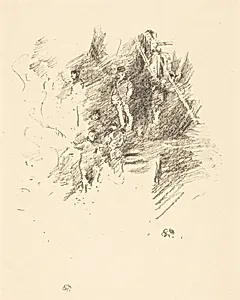
Medium
lithograph in black on laid paper
Dimensions
image: 16.6 × 16.5 cm (6 9/16 × 6 1/2 in.) sheet: 28.2 × 22.8 cm (11 1/8 × 9 in.)
Classification
Department
CG-W
Museum
National Gallery of Art, Washington, D.C.
Credit
Rosenwald Collection
Accession Number
1943.3.8755
Rights
Public Domain
Art Historical Context
James McNeill Whistler’s *Fifth of November* (1895) captures the explosive energy of Guy Fawkes Night, the British celebration commemorating the foiled Gunpowder Plot of 1605 with bonfires and fireworks. This lithograph in black on laid paper depicts a nocturnal scene, likely along the Thames River, where bursts of light pierce the dark sky. Measuring just 16.6 × 16.5 cm, its small scale invites close viewing, revealing Whistler’s mastery of subtle tonal gradations. As a leading figure in the Aesthetic movement, Whistler prioritized “art for art’s sake,” emphasizing mood and harmony over narrative. Here, his lithographic technique—employing transfer methods for fluid, painterly effects—evokes the fleeting magic of fireworks against a velvety night. Printed late in his career, it reflects his innovative printmaking from the 1880s and ’90s, blending Impressionist atmosphere with Japanese-inspired simplicity. Housed in the National Gallery of Art’s Rosenwald Collection, this work exemplifies Whistler’s enduring influence on modern printmaking, transforming everyday spectacle into poetic abstraction. Visitors will appreciate its rhythmic composition, a testament to his belief that art should harmonize like music.
About the Artist
James McNeill Whistler · 1834–1903
James Abbott McNeill Whistler (1834-1903) was an American-born painter and printmaker who became a leading figure in the Aesthetic Movement and pioneer of Tonalism and Japonisme. He revolutionized art by championing "art for art's sake" and treating paintings as visual equivalents of musical compositions, titling works as "arrangements," "harmonies," and "nocturnes" to emphasize formal qualities o...