
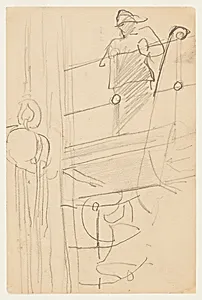
Figure in Oilskins at a Ship's Railing
Classification
seascapes
Department
Smithsonian Collection
Museum
Smithsonian American Art Museum
Credit
Gift of Charles Savage Homer, Jr.
Accession Number
1912-12-245
Rights
Public Domain
About this artwork
Research in Progress
Art Historical Context
Winslow Homer, one of America's foremost Realist painters (1836–1910), captures the raw drama of the sea in *Figure in Oilskins at Ship's Railing*ca. 1895). By the mid-1890s, Homer had retreated to his coastal studio in Prouts Neck, Maine, where he himself in depicting the relentless power of the Atlantic. This seascape likely portrays a solitary figure clad in oilskins—traditional waterproof gear for sailors—gripping a ship's railing amid turbulent waters, evoking the perilous life of seafarers in the late 19th century. Homer's mastery lies in his unflinching realism, using bold brushwork and dynamic composition to convey nature's indifference to human fragility. Though the medium is unknown, his seascapes from this period often employed vibrant oils to render crashing waves and stormy skies with visceral intensity. Classified as a seascape in the Smithsonian American Art Museum's collection—gifted by Charles Savage Homer, Jr.—it exemplifies Homer's shift toward monumental marine subjects that celebrated American resilience. This work invites visitors to ponder the cultural romance of the sea in Gilded Age America, where maritime labor symbolized national grit. Research continues, promising deeper insights into Homer's enduring legacy.