
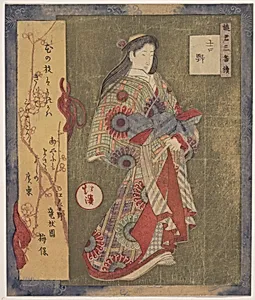
Figure of a Woman
Medium
Woodblock print (surimono); ink and color on paper
Dimensions
8 1/8 x 6 13/16 in. (20.6 x 17.3 cm)
Classification
Prints
Culture & Period
Japan · Edo period (1615–1868)
Department
Asian Art
Museum
Metropolitan Museum of Art, New York, NY
Credit
H. O. Havemeyer Collection, Bequest of Mrs. H. O. Havemeyer, 1929
Accession Number
JP1813
Rights
Public Domain
Tags
Art Historical Context
In the vibrant world of Edo-period Japan (1615–1868), Totoya Hokkei's *Figure of a Woman* the elegance of everyday beauty through the intimate art of surimono—a type of privately commissioned woodblock. Hokkei, a ukiyo-e artist pupil of the famed Katsushika Hokusai, specialized in these luxurious, limited-edition works, often featuring poetry and exquisite color layering. Printed with ink and color on paper, this small gem (just 8 1/8 x 6 13/16 inches) exemplifies the precision of Japanese woodblock techniques, where carvers and printers achieved subtle gradients and metallic accents for poetic refinement. Surimono like this one were typically created for special occasions, such as New Year's celebrations or personal gifts, blending artistry with cultural ritual. The solitary female figure evokes the bijin-ga tradition—depictions of graceful women symbolizing ideal femininity amid urban life's "floating world." Its cultural significance lies in democratizing high art for elite patrons, preserving fleeting moments of poise and allure. Now part of the Metropolitan Museum of Art's H. O. Havemeyer Collection, this print invites visitors to appreciate the meticulous craftsmanship that made Edo Japan a golden age of printmaking.
About the Artist
Totoya Hokkei · 1780–1850
Totoya Hokkei (魚屋 北渓, 1780–1850), born Iwakubo Tatsuyuki in Edo (modern Tokyo), began his life as a humble fishmonger in the Yotsuya Samegahashi district, a trade reflected in his art name "Totoya," meaning fish shop. He transitioned to art through rigorous training, first studying under Kanō Yōsen'in Korenobu, head of the Kobikichō branch of the prestigious Kanō school, where he honed landscape p...