
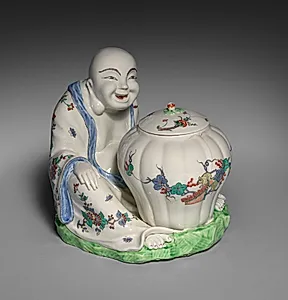
Figure of Budai or Hotei with Jar
c. 1735–40
Medium
Tin-glazed soft-paste porcelain with enamel decoration
Dimensions
h. 17.2 cm
Classification
Ceramic
Department
Decorative Art and Design
Museum
Cleveland Museum of Art
Credit
Grace Rainey Rogers Fund
Accession Number
1947.62
Rights
Public Domain
Tags
About this artwork
The production of decorative figures like this one, referred to as magots or pagodes in European texts, was the result of an 18th-century European interest in Chinese and Japanese culture and porcelain. Budai, pronounced Hotei in Japanese, was a semilegendary Chinese monk known in Japan through the transmission of Chan Bhuddism. This figure’s decoration with multicolor overglaze enamels on a milky-white is typical of Japanese Kakiemon style.
About the Artist
Chantilly Porcelain Factory (French)
Georges Hugnet (1906–1974) was a multifaceted French artist, poet, writer, and critic whose innovative collages and graphic works bridged Dada and Surrealism. Born in Paris on July 11, 1906, he spent much of his early childhood in Buenos Aires, Argentina, returning to France around 1913. His early life and artistic training remain sparsely documented, with no records of formal art school attendanc...