
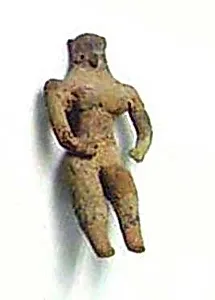
Figure of Fertility Goddess
Unknown Artist
ca. 2700–2000 BCE
Medium
Terracotta
Dimensions
H. 5 1/4 in. (13.3 cm); W. 2 in. (5.1 cm); D. 1 3/4 in. (4.4 cm)
Classification
Ceramics
Culture
Baluchistan
Department
Asian Art
Museum
Metropolitan Museum of Art, New York, NY
Credit
Gift of Jeannette and Jonathan Rosen, 2001
Accession Number
2001.794.232
Rights
Public Domain
Tags
Art Historical Context
This petite terracotta figure, standing just over 5 inches tall, embodies a Fertility Goddess from ancient Baluchistan, dating to around 2700–2000 BCE. Crafted during the Bronze Age, it hails from the broader Indus Valley cultural sphere, where such handheld sculptures were likely cherished as votive offerings or household talismans. The region's early agrarian societies revered these deities as symbols of abundance, fertility, and life's cycles, reflecting deep spiritual beliefs in a world dependent on the land's bounty. Hand-modeled from fired clay—a durable, accessible medium for ancient potters—the figurine's simple, stylized form highlights the artistry of its unknown creator. Its compact dimensions (H. 5¼ in.; W. 2 in.; D. 1¾ in.) suggest it was meant for intimate devotion, perhaps placed in shrines or homes. Terracotta's earthy warmth and permanence made it ideal for enduring rituals across millennia. Today, this gift to the Metropolitan Museum of Art from Jeannette and Jonathan Rosen in 2001 invites us to connect with the timeless human quest for prosperity. Gaze upon her and ponder the ancient voices whispering hopes for plentiful harvests and thriving families.