
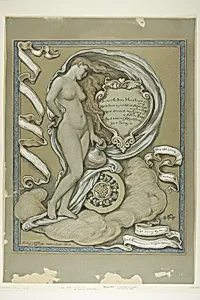
Figure Study for Rubaiyat of Omar Khayyam
c. 1884, reworked 1911
Medium
Black wax crayon and a variety of colored wax crayons with graphite and touches of gold pigment, heightened with white gouache on blue wove paper (discolored) laid down on tan board
Dimensions
64.9 × 46.6 cm (25 9/16 × 18 3/8 in.)
Classification
crayon
Department
Prints and Drawings
Museum
Art Institute of Chicago
Accession Number
55739
Rights
Public Domain
Art Historical Context
Elihu Vedder’s *Figure Study for Rubaiyat of Omar Khayyam* captures the artist’s meticulous preparation for one of the most celebrated illustrated books of the late nineteenth century. Created around 1884 and reworked in 1911, this drawing served as a preparatory study for Vedder’s lavish edition of Edward FitzGerald’s translation of the eleventh-century Persian poet Omar Khayyam. The work reflects the era’s fascination with exotic literary themes and the Symbolist interest in evoking mood and mystery through the human form. The medium itself reveals Vedder’s experimental approach. Working in black and colored wax crayons, graphite, touches of gold pigment, and white gouache on blue paper, he achieved rich tonal contrasts and luminous highlights that would later translate into the book’s distinctive plates. The drawing’s substantial scale—nearly 26 by 19 inches—suggests it was meant to be viewed closely, allowing the artist to refine gesture, drapery, and expression before committing to the final illustrations. Today housed in the Prints and Drawings department of the Art Institute of Chicago, the piece offers visitors a rare glimpse into an artist’s process. Its reworking decades after the original publication hints at Vedder’s enduring engagement with Khayyam’s verses and the timeless appeal of the Rubaiyat’s philosophical imagery.
About the Artist
Elihu Vedder · 1836–1923
Elihu Vedder was born on February 26, 1836, in New York City to Dr. Elihu Vedder Sr., a dentist, and his cousin Elizabeth Vedder. As a young boy, his family relocated to Cuba for his father's ventures, an experience that sparked his artistic aspirations amid the Caribbean landscapes. He later divided his time between a boarding school and his maternal grandfather Alexander Vedder's home in Schenec...